
Writing
What is Performance Marketing and How It Helps Businesses Grow
In today’s fast-paced digital world, businesses are constantly looking for ways to maximize their return on investment (ROI) while minimizing wasted spending. This is where Performance Marketing comes into play. Unlike traditional marketing methods where you pay upfront without guaranteed results, performance marketing focuses on measurable outcomes—meaning you only pay when specific actions are completed.
In this blog, we’ll explore what performance marketing is, how it works, and why it has become a game-changer for businesses of all sizes.
What is Performance Marketing?
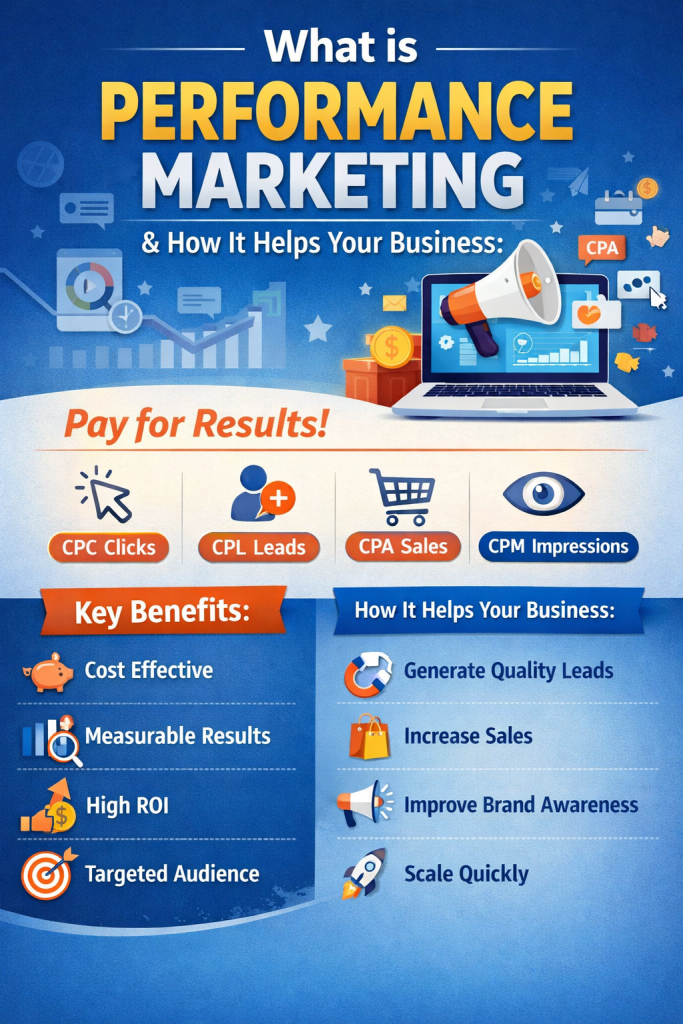
Performance marketing is a type of digital marketing where advertisers pay only when a specific action is achieved. These actions could include:
- Clicks (CPC – Cost Per Click)
- Leads (CPL – Cost Per Lead)
- Sales (CPA – Cost Per Acquisition)
- Impressions (CPM – Cost Per Mille)
In simple terms, performance marketing is results-driven marketing. Instead of paying for exposure alone, businesses pay for actual outcomes.
How Performance Marketing Works
Performance marketing operates through a combination of platforms, channels, and strategies. Here’s how the process typically works:
1. Setting Clear Goals
Businesses define what they want to achieve—whether it’s website traffic, leads, or sales.
2. Choosing the Right Channels
Common performance marketing channels include:
- Search Engine Marketing (Google Ads)
- Social Media Advertising (Facebook, Instagram, LinkedIn)
- Affiliate Marketing
- Native Advertising
- Email Marketing
3. Running Targeted Campaigns
Ads are shown to a specific audience based on demographics, interests, behavior, and location.
4. Tracking Performance
Using tools like analytics and tracking pixels, marketers monitor user actions and campaign performance.
5. Optimization
Campaigns are continuously optimized to improve results and reduce costs.
Key Components of Performance Marketing
To fully understand performance marketing, it’s important to know its core components:
1. Advertisers
Businesses or brands looking to promote their products or services.
2. Publishers
Platforms or websites where ads are displayed.
3. Affiliate Networks
Third-party platforms that connect advertisers with publishers.
4. Tracking & Analytics Tools
Tools that measure performance and provide insights into user behavior.
Benefits of Performance Marketing for Businesses
Performance marketing offers several advantages that make it highly effective for modern businesses:
1. Cost-Effective Strategy
You only pay for actual results, which ensures better budget utilization and reduces unnecessary spending.
2. Measurable Results
Every campaign can be tracked in real-time, allowing businesses to measure success accurately.
3. Better ROI
Since campaigns are optimized continuously, businesses often achieve higher returns compared to traditional marketing.
4. Targeted Audience Reach
Advanced targeting options ensure your ads reach the right people at the right time.
5. Scalability
Successful campaigns can be scaled quickly to generate more leads and sales.
Types of Performance Marketing Channels
1. Search Engine Marketing (SEM)
Paid ads on search engines help businesses appear at the top of search results, driving high-intent traffic.
2. Social Media Advertising
Platforms like Facebook and Instagram allow businesses to target users based on interests and behavior.
3. Affiliate Marketing
Businesses partner with affiliates who promote their products and earn a commission for each sale.
4. Native Advertising
Ads blend seamlessly with content, improving user engagement and click-through rates.
5. Influencer Marketing
Collaborating with influencers helps brands reach a wider audience with authentic recommendations.
Why Performance Marketing is Important in 2026
With increasing competition in the digital space, businesses can no longer rely on guesswork. Performance marketing provides:
- Data-driven decision-making
- Real-time insights
- Faster results
- Improved customer targeting
As consumers spend more time online, performance marketing ensures that businesses stay relevant and competitive.
How Performance Marketing Helps Business Growth
1. Generates Quality Leads
By targeting the right audience, businesses attract users who are more likely to convert.
2. Increases Sales
Optimized campaigns focus on conversions, leading to higher revenue.
3. Improves Brand Awareness
Even performance-based campaigns contribute to brand visibility and recognition.
4. Enhances Customer Insights
Businesses gain valuable data about customer behavior, preferences, and buying patterns.
5. Supports Business Expansion
With scalable campaigns, businesses can expand into new markets easily.
Best Practices for Performance Marketing
To get the best results, businesses should follow these best practices:
- Set clear and measurable goals
- Use high-quality creatives and ad copy
- Test multiple campaigns (A/B testing)
- Monitor performance regularly
- Optimize campaigns based on data
- Focus on landing page experience
Challenges in Performance Marketing
While performance marketing is highly effective, it also comes with challenges:
- High competition in popular niches
- Constant need for optimization
- Ad fatigue among users
- Dependency on data accuracy
However, with the right strategy and tools, these challenges can be managed effectively.
Conclusion
Performance marketing has transformed the way businesses approach digital advertising. By focusing on measurable results and ROI, it offers a smarter, more efficient way to grow in the competitive online landscape.
Whether you’re a startup, small business, or large enterprise, performance marketing can help you generate leads, increase sales, and scale your business effectively.
If you’re not already using performance marketing, now is the perfect time to start and unlock the full potential of digital growth.
🚀 Ready to grow your business with performance marketing?