
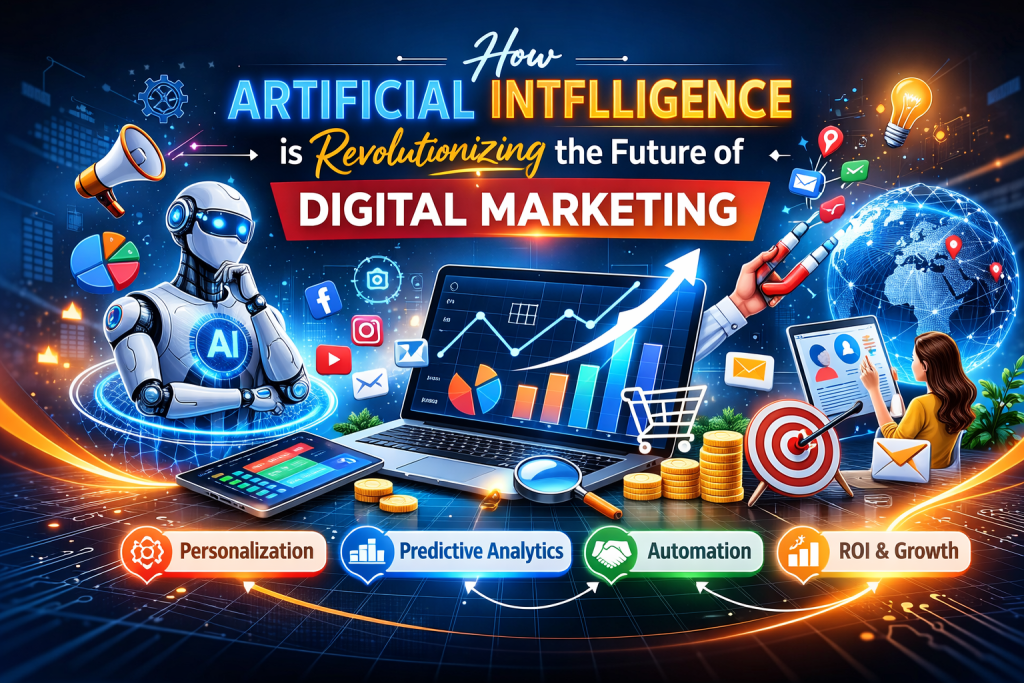
The Role of AI in Modern Digital Marketing
Businesses using AI have a major edge in the cutthroat internet ecosystem of today. In addition to increasing marketing effectiveness, artificial intelligence is revolutionising customer experiences, streamlining campaigns, and providing data-driven insights that were previously unattainable.
This blog will discuss how AI is transforming digital marketing, the technologies that are causing this change, and how companies can strategically use AI to stay competitive in the digital age.
1.Hyper-Personalization at Scale
Instead of being a luxury, personalisation is now required. Customers anticipate that brands will be aware of their preferences and offer experiences that are customised for them.
AI makes possible:
Customised topic lines for emails
Content for dynamic websites
2.AI-Powered Chatbots and Virtual Assistants
AI-powered chatbots have revolutionised customer service. Automated chat systems are now used by businesses to offer round-the-clock support without the need for human participation.
Chatbots are capable of:
Respond to commonly requested questions
Help customers make purchases
3.Smarter Advertising with Predictive Analytics
Online advertising has drastically transformed because to AI. AI determines which users are most likely to convert by analysing behavioural data, as opposed to speculating on which audience to target.
Machine learning algorithms are used by advertising networks like Google Ads and Facebook Ads to:
Improve your bidding tactics.
4.Content Creation and Optimization
These days, AI helps with SEO optimisation, keyword research, and content creation. AI-powered tools assist marketers:
Determine the most popular keywords
Examine the substance of competitors.
Make suggestions for improving the headline
Improve the readability
5.Voice Search and AI Integration
Voice assistants are becoming increasingly popular, changing the way users search online. AI enables voice recognition systems to understand natural language queries.
Devices powered by Apple and Amazon have made voice search mainstream.
To adapt, marketers must:
- Focus on conversational keywords
- Optimize for local search
- Provide direct answers to queries
Voice search optimization is becoming a critical part of SEO strategy.
6.AI in Social Media Marketing
Social media platforms rely heavily on AI algorithms to determine what content users see.
Platforms like Instagram and LinkedIn use AI to:
- Analyze user engagement
- Recommend content
- Improve ad targeting
- Detect trends
AI helps brands understand audience behavior and create data-driven social media strategies.
Key Benefits of AI in Digital Marketing
Artificial Intelligence offers several powerful advantages:
1. Improved Efficiency
Automation reduces manual work and saves time.
2. Better Customer Insights
AI analyzes massive datasets quickly, revealing valuable patterns.
3. Higher Conversion Rates
Personalized experiences increase engagement and sales.
4. Cost Optimization
Smarter targeting reduces wasted ad spend.
5. Real-Time Decision Making
AI tools provide instant performance analysis and adjustments.
Businesses leveraging AI can operate faster and smarter than competitors relying on traditional methods.
Challenges of AI in Digital Marketing
While AI offers immense benefits, it also comes with challenges:
- Data privacy concerns
- High initial investment
- Dependence on accurate data
- Need for technical expertise
Marketers must balance automation with human creativity and ethical responsibility.